Last reviewed 31 October 2026
A GMRS license costs $35, lasts ten years, and requires no test. None of that is the hard part. The hard part is that the FCC splits the job across two websites with similar names, and almost every guide on the internet, including the one on myGMRS.com, starts at step two. They tell you to log into something called the License Manager with something called an FRN, as if you already had one. Most people stall right there, before they have done anything wrong.
This guide starts at the actual beginning. If your radios are already on the shelf, this is the fifteen minutes that makes them fully legal to use at full power, on repeater channels, for you and your immediate family.
The whole process on one screen
So the rest makes sense, here is the entire thing in four moves:
- CORES is the FCC's identity office. You create a username account there and get an FRN, a ten digit registration number that is yours for life.
- ULS License Manager is where licenses are filed. You log in with your FRN, pick GMRS from a list, and submit a short form.
- You pay $35, within ten calendar days or the application is thrown out.
- A few business days later you have a call sign, which is the license. It arrives by email and as a downloadable PDF. Nothing comes in the mail.
Two systems, two logins that are really one identity. Keeping them straight is most of the battle.
Before you start
- A computer, not a phone. The FCC sites are old and the menus behave badly on small screens.
- About 15 to 20 minutes, uninterrupted. The payment deadline only starts once you submit, but the account setup has email verification steps you do not want to abandon halfway.
- Your Social Security number. Registering for an FRN as an individual asks for a taxpayer ID. This surprises people, and it is normal. It is how the FCC ties the number to one person.
- A payment card for the $35 fee.
Eligibility is simple: you must be 18 or older and not a representative of a foreign government. That is the whole test, and there is no other test.
One warning that will save you money: file only on fcc.gov. Search results are full of services that charge $75 to $150 to “handle” this for you. They file the same form on the same website and keep the difference. The FCC fee is $35, total, and it is the only amount you should ever pay.
Part 1: Get your FCC username and FRN (CORES)
- Go to the FCC's Commission Registration System (CORES) and choose to register a username account.
- Verify your email and set up the sign-in security it asks for, including two-factor authentication. This account is how the FCC knows you across all of its systems.
- Logged into CORES, choose Register New FRN and register as an individual. You will confirm a U.S. address and enter your taxpayer ID.
- The system assigns your FRN immediately. Write it down with the password you set. You will use this number for every FCC license you ever hold.
Already have an FRN from any other FCC license, including an amateur radio license? Do not create a second one. In CORES you can associate your existing FRN with your username account instead. Two FRNs for one person creates exactly the kind of tangle that takes a support call to unwind.
Part 2: File the application (ULS License Manager)
- Go to the ULS License Manager and log in with your FRN and password.
- On the left side of the page, click Apply for a New License.
- In the radio service drop-down, scroll to the bottom and choose ZA: General Mobile Radio Service (GMRS). It sits at the end of a long alphabetical list, which is why people think it is missing.
- Work through the screens. Two answers worth knowing in advance: STA request: No, and fee exemption: No. As an individual you are not exempt, and the $35 applies to everyone.
- The eligibility questions that follow are answered No by nearly everyone. Read them, answer honestly, continue.
- On the Summary page, check your name and address character by character. This is what prints on the license.
- Click Continue to Certify, type your name in the signature boxes (the Title box is optional), and click Submit.
Part 3: Pay the $35 (do not skip this, and do not delay it)
Submitting the application is not finishing. The FCC fee must be received within 10 calendar days of filing or the application is dismissed and you start over.
Pay in the same sitting, because coming back later means finding this screen again. And here is the part that trips everyone, including us the first time: clicking Continue for Payment Options (or Pay Now) does not open a payment form. It bounces you back to a CORES login page, which looks like something went wrong. Nothing went wrong. That login page is the payment system's front door. Its own bullet list gives it away, if you read closely: one of the things CORES says it lets you do is “Retrieve and pay ULS fees.”
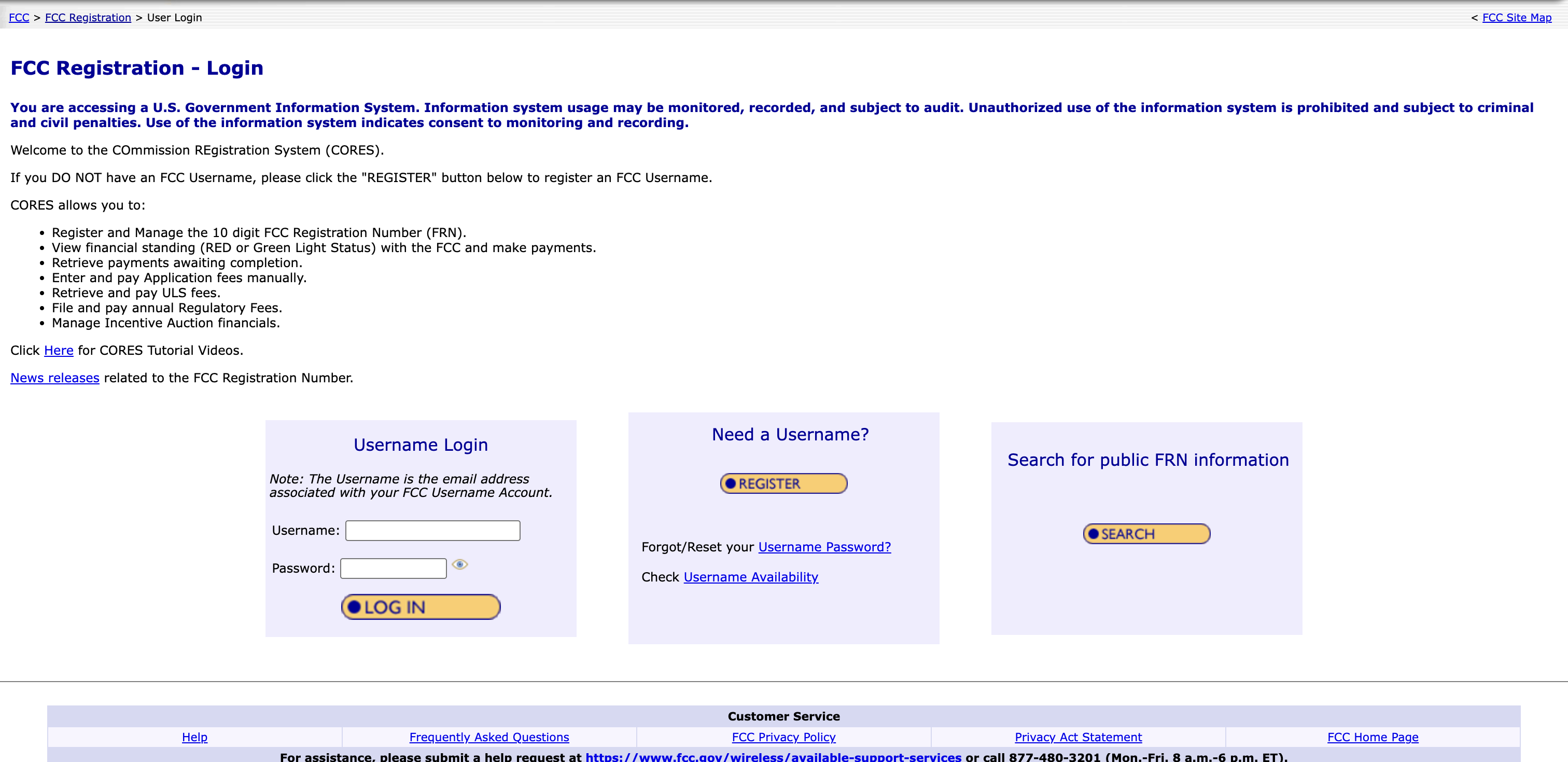
Log in with your FCC username (your email address) and password. You land on a User Home page with a short list of links, and not one of them says Pay. The one you want is Manage Existing FRNs | FRN Financial | Bills and Fees. Its description is the giveaway: “View & Pay Regulatory Fees, Application Fees, and Bills.”
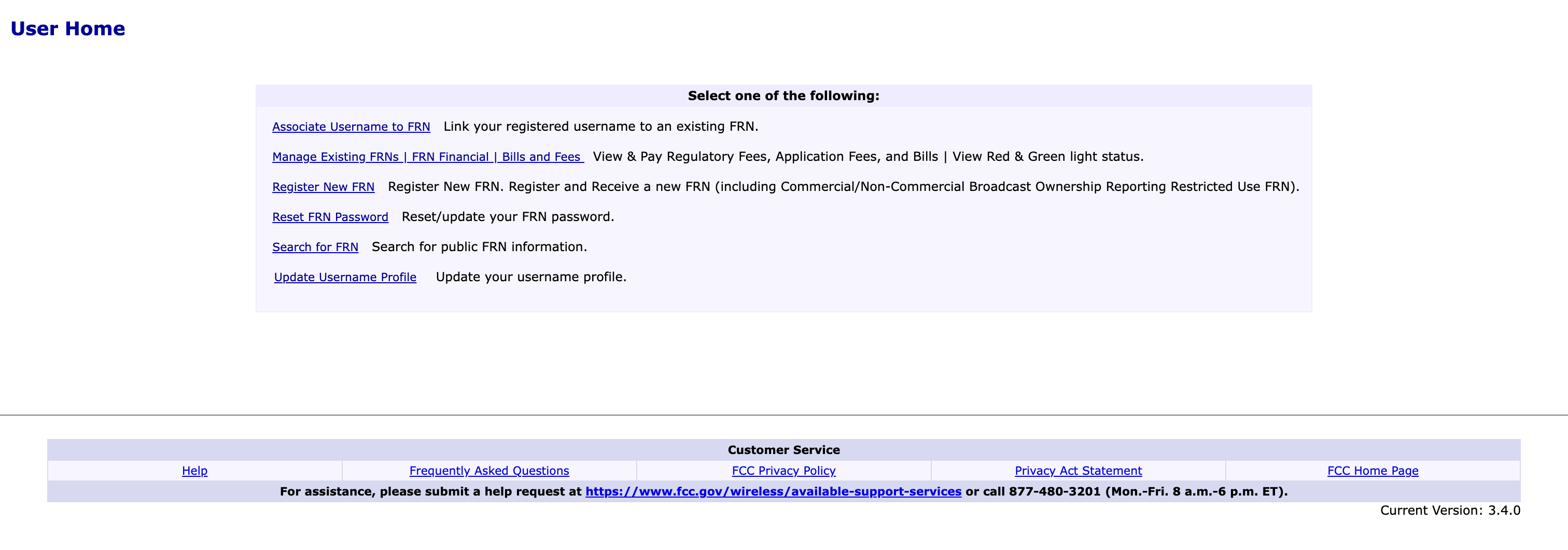
Open it, find the $35 fee tied to your application, and pay by card. Save the confirmation and your application file number somewhere you will find them again.
Part 4: After the grant
- Processing usually takes a few business days once payment clears.
- The FCC no longer mails paper licenses. If you put an email address on the application, an official copy is emailed to you when it is granted.
- You can also download it yourself: log back into License Manager, click Download Electronic Authorizations, select your call sign, add it to the download box, and save the PDF. Print a copy and keep it with your radios.
What you receive is a call sign, a short code like the ones radio operators use on air. It is not your FRN. The FRN is your account number with the FCC; the call sign is your license.
On the radio, the rule is simple: say your call sign at the end of a conversation, and every 15 minutes during a long one. Family members operating under your license use the same call sign.
Renewal: you can renew in the 90 days before the license expires, for the same $35. Miss the expiry date and you file a new application instead.
Who your one license covers
This is the part most people under-read, and it is the reason GMRS fits families so well. One license, held by one adult, authorizes their immediate family to operate, at any age. The FCC's definition is wider than a household:
Spouse, children, grandchildren, stepchildren, parents, grandparents, stepparents, brothers, sisters, aunts, uncles, nieces, nephews, and in-laws.
Your relatives do not file anything. There is no per-person or per-radio fee. One $35 license can legitimately cover the family group chat that matters in an outage, including relatives across town, as long as everyone is operating under the licensee's system.
The five ways people actually get stuck
- Starting at the License Manager with no FRN. Every guide assumes it; almost nobody has one. Part 1 above is the missing first step.
- Creating a second FRN because the first was forgotten. Search for your existing FRN before registering a new one.
- Submitting and never paying. Ten days passes quietly and the application is dismissed with no license and no error you would notice.
- Paying a third-party site real money to file a free-to-file form. The FCC fee is $35 and the address bar should say fcc.gov.
- Waiting for something in the mail. Nothing is coming. Your license is an email and a PDF, and it is valid the moment it is granted.
If you get genuinely stuck mid-process, the FCC Licensing Support Center takes calls at (877) 480-3201, Monday to Friday, 8 a.m. to 6 p.m. Eastern.
What the license unlocks, and what it does not
The license lets you and your family legally use GMRS at full power and, more importantly, through repeaters: privately owned stations on high ground that receive your signal and rebroadcast it across a county or more. That is the difference between a radio that reaches down the street and one that reaches across the county, and repeaters are the reason the license is worth having rather than a formality.
It does not program your radios, find your local repeaters, or test whether any of it works from your actual driveway. That is the next job, and it has to happen on an ordinary afternoon, not during a storm warning. Our family communications plan walks through it: how the phone network fails in stages, what handheld range really is, and how to find and program the repeaters near you before you need them.
Sources: FCC, General Mobile Radio Service (GMRS) licensing pages and Universal Licensing System (ULS) License Manager; FCC Commission Registration System (CORES); GMRS rules at 47 CFR Part 95, Subpart E (including §95.1705 on family eligibility and §95.1751 on station identification); FCC application fee schedule for personal radio services ($35, set April 2022); filing instructions mirrored at myGMRS.com.